
Superbuy Shipping Calculator: Compare Inputs Before Comparing Prices
The Superbuy shipping calculator is useful when you can explain the parcel behind its estimate. A number produced from guessed dimensions is not the same thing as a charge for a measured, packed shipment.
The public estimator asks for a destination, warehouse, weight in grams, dimensions in centimetres and item category. Its help text explains first and additional weight units and presents a volume-weight example. Read the charging conditions for the route you are considering instead of applying one rule to every result.
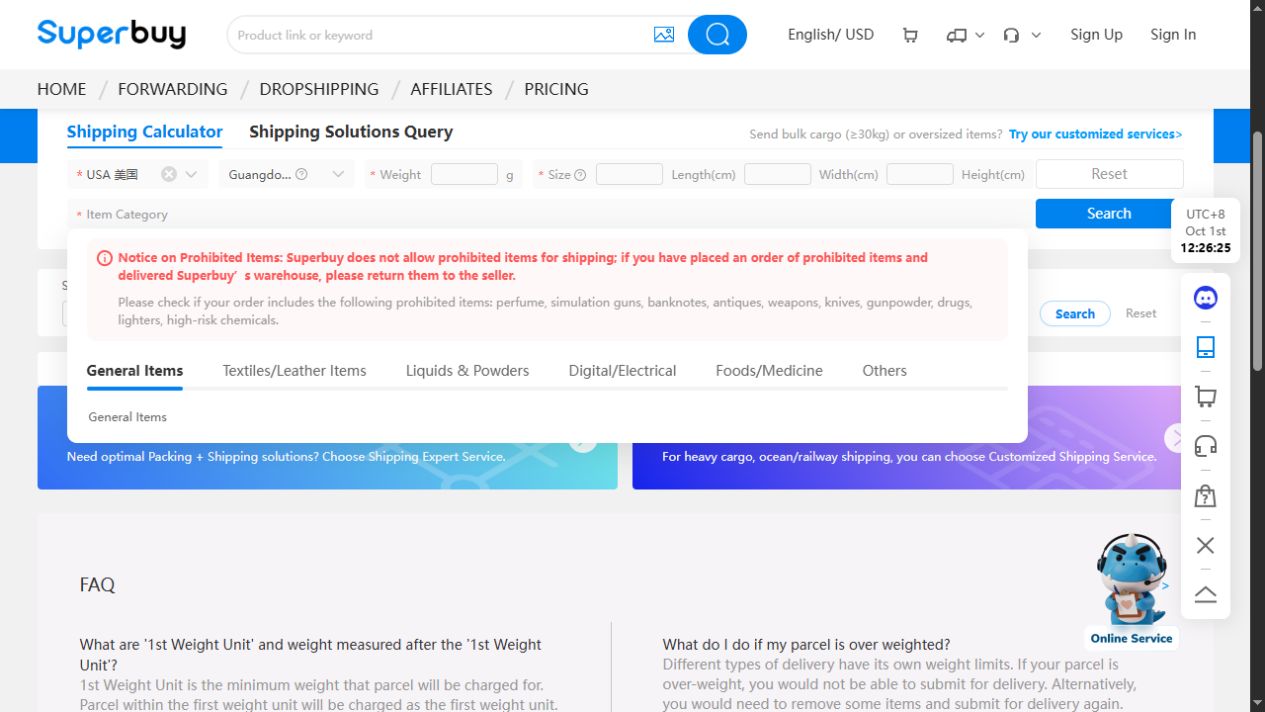
The calculator view captured on 1 October 2026 shows the USA selected and blank parcel measurements. It illustrates the input units and restriction notice, not a calculated price or a completed shipment.
Prepare a reproducible estimate
Start by separating measured information from assumptions. If the parcel has not been packed, label the dimensions as a planning estimate in your own notes. Do not present a product's dimensions as though they included the shipping box and protective material.
Record:
- The destination and relevant delivery details.
- Which items and quantities are included.
- Weight and its unit.
- Length, width and height with their units.
- Whether measurements describe the items or the packed parcel.
- Any packaging or service choice included in the comparison.
Keep an initial estimate so you can explain why a later figure changed. This is more useful than repeatedly editing the same number without preserving its assumptions.
Check units before interpreting the result
A kilogram value entered into a gram field can radically change the question being asked. Similarly, a millimetre measurement is not a centimetre measurement. Convert deliberately: 2 kg is 2,000 g, and 300 mm is 30 cm.
Check every dimension, not just the longest edge. A bulky light object can occupy substantial space even when the scale weight looks modest. The shipping guide explains why contents and packing must stay consistent across comparisons.
Understand volume without assuming a universal divisor
Superbuy's public help illustrates volume weight with length × width × height divided by 6,000 when the dimensions are centimetres and the result is kilograms. That is an explanatory example, not evidence that every listed service uses that divisor or the same rounding method.
Consider a hypothetical carton measuring 40 × 30 × 25 cm. Its volume is 30,000 cubic centimetres. Under that illustrative divisor, the volume weight is 5 kg. If its scale weight is 3 kg, the two figures differ; the service's actual charging rules determine which figure applies.
If the height became 20 cm, the volume would be 24,000 cubic centimetres, or 4 kg under the same illustrative calculation. This arithmetic does not prove a fee reduction. The route's increments, minimum charge and actual packing outcome still matter.
Read the first-weight and additional-weight rule
A tariff may charge an initial unit and then further increments rather than a single flat rate per kilogram. Identify the size of those increments and the rule for a partial increment.
For illustration only, suppose a tariff charges 40 units for the first 500 g and 15 for each additional started 500 g. A 1,200 g chargeable weight contains the first unit plus two additional started units: 40 + 15 + 15 = 70 units.
That is not a Superbuy quote. It demonstrates why multiplying a rounded kilogram figure by a headline rate can give the wrong answer. Use the conditions actually shown for the selected service.
Change one assumption at a time
If you want to assess a packing change, compare two estimates that differ only in the relevant packing inputs. Keep destination, contents and other service choices fixed. If the route changes too, identify that as a separate decision rather than attributing the entire price difference to a smaller box.
A useful comparison is “same items with retail boxes retained versus removed under the same eligible service.” An unhelpful comparison changes the items, route, destination and packaging together, leaving no clear explanation for the result.
Do not remove necessary protection simply because an arithmetic example looks cheaper. Ask what the actual packing arrangement would be.
Reconcile the estimate with the next payable amount
When a later amount differs, compare the inputs before assuming an error. Did packing measurements change? Was a different service selected? Are additional services now included? Are the displayed currency and conversion basis the same?
Ask for a breakdown of the specific difference. An estimate, a requested deposit and a final charge are different kinds of record; label them accordingly in your budget.
Keep product cost, Chinese domestic delivery and import-related costs separate unless the quoted scope expressly includes them. An attractive shipping figure does not establish your total delivered cost.
Frequently asked questions
Can I use another buyer's weight?
It can prompt a planning question, but it is not a measurement of your parcel. Quantity, selected version, packaging and included accessories can differ.
Does a result mean every item is permitted?
No. Read the contents restrictions and service conditions. A category control is not permission to ignore an explicit prohibited-items notice.
Can this tell me the exact arrival date?
A price calculation cannot establish an arrival date. Use the delivery-time guide to interpret any displayed time range.
Where does this fit into the spreadsheet workflow?
Keep candidate selection in your Superbuy spreadsheet, verify product links, then use the ordering guide to distinguish item purchase from parcel preparation. Estimate the parcel you intend to send, and recheck after its relevant inputs change.
A footwear example makes the distinction concrete: view this Air Max 95 listing on Superbuy to identify the item, then enter measured or clearly labelled assumed parcel dimensions in the calculator. Do not use the product photograph as evidence of packed weight.